PBTCA vs HEDP for Cooling Water: When Is the More Expensive Phosphonate Worth It?
Key takeaways
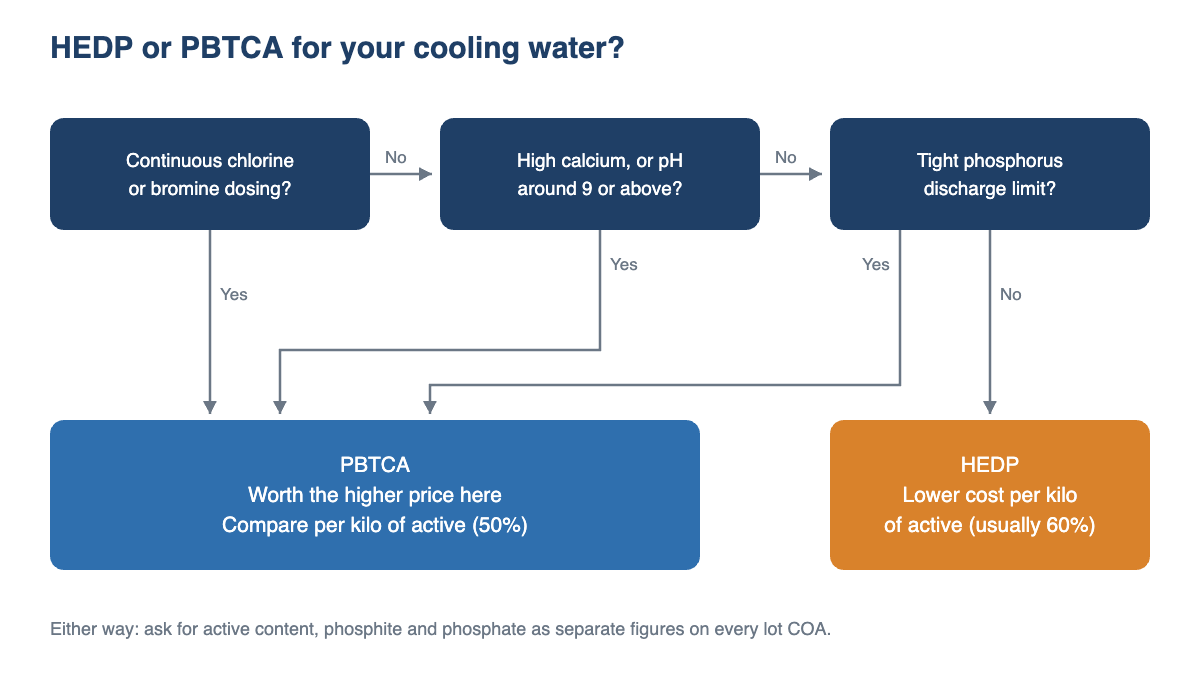
- Use HEDP for moderate-hardness water without continuous chlorination, where cost per kilo of active matters most. Pay for PBTCA when calcium is high, pH runs around 9 or above, or you dose chlorine or bromine continuously.
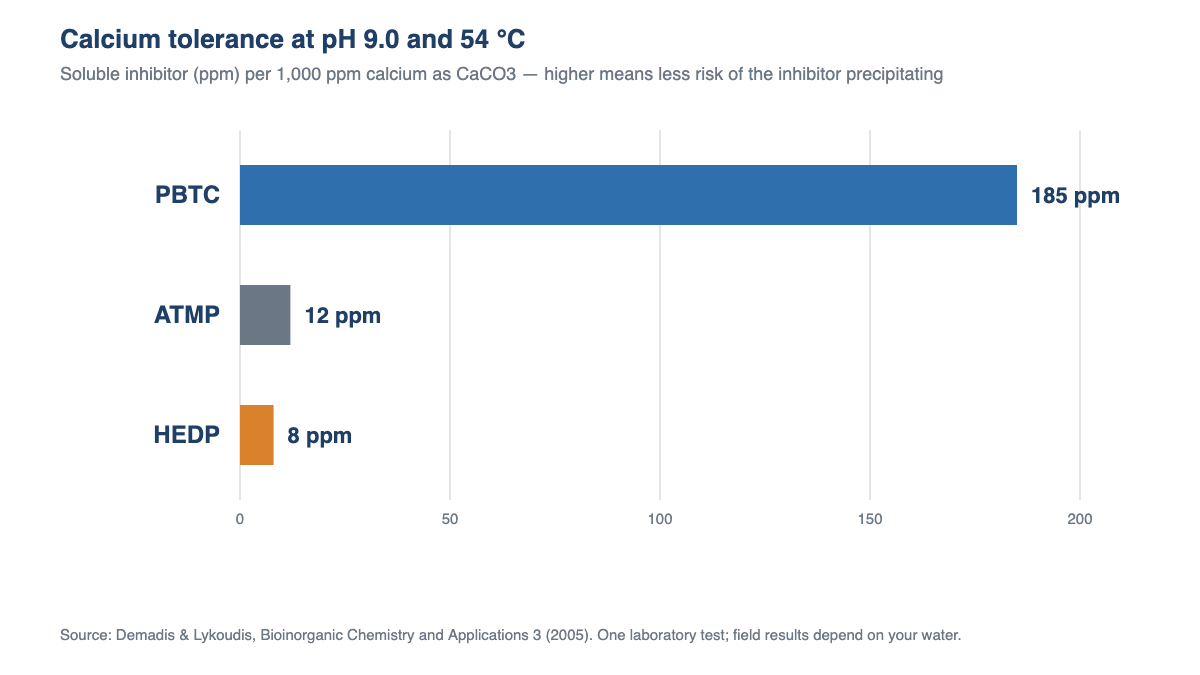
- In one published test at pH 9 e 54 °C, PBTC stayed in solution at 185 ppm per 1,000 ppm calcium (as CaCO3); HEDP managed only 8 ppm.
- Compare offers per kilo of active, not per kilo of liquid. 60% HEDP is the export standard and PBTCA is sold at 50%; per kilo of active, PBTCA usually costs 1.6 para 2.0 times as much.
- Ask for measured phosphite and phosphate on every COA. In our experience large producers hold phosphite at 0.2–0.4%, while weak lots from smaller plants reach 0.6–1.2%.
By David, Founder & Sales Director, SUNCHEM — 25 years in chemical export sales.
Publicado: 8 October 2026
If your cooling water is hard, alkaline or continuously chlorinated, PBTCA (2-phosphonobutane-1,2,4-tricarboxylic acid) is usually worth its higher price over HEDP (1-hydroxyethylidene-1,1-diphosphonic acid). If none of those apply, HEDP does the job for less. Before you compare prices, convert every offer to cost per kilo of active.
Both are phosphonates: phosphorus-based scale inhibitors that stop calcium carbonate from depositing on heat-exchange surfaces at a few ppm. They are not interchangeable once the water gets difficult.
Contents
PBTCA vs HEDP: where the difference shows up
The differences matter most under three kinds of stress: high calcium, high pH and oxidising biocides.
| Point | HEDP (CAS 2809-21-4) | PBTCA (CAS 37971-36-1) |
|---|---|---|
| Usual commercial form | 60% liquid for export; 50% mostly sold in China; solid grades also offered | Líquido, 50% active |
| Calcium tolerance (pH 9, 54 °C) | 8 ppm per 1,000 ppm Ca (as CaCO3) | 185 ppm per 1,000 ppm Ca (as CaCO3) |
| Chlorine and bromine | Slowly broken down under continuous chlorination, releasing orthophosphate | No appreciable breakdown with 5 ppm chlorine or bromine over 1 h (lab test) |
| Phosphorus in the active (calculated) | 30.1% | 11.5% |
Calcium tolerance is the amount of inhibitor that stays dissolved instead of dropping out as a calcium salt. Once the inhibitor precipitates, it stops working and can add to the deposit. The figures come from a University of Crete study that tested PBTC, HEDP and ATMP (amino trimethylene phosphonic acid, called AMP in the study) side by side; ATMP reached 12 ppm.
The same study found PBTC "virtually immune" para 5 ppm chlorine or bromine for an hour at pH 8.3. HEDP is more vulnerable: under continuous chlorination it slowly breaks down to orthophosphate, which is why patents exist for stabilisers that protect it. In our enquiries HEDP far outnumbers PBTCA; buyers who ask for PBTCA usually run high-pH, high-hardness or chlorinated systems, or zinc-based programmes.
What Chinese supply looks like
If you buy from China, HEDP is made to a national standard: GB/T 26324 sets at least 50% active for the liquid grade and caps phosphite at 2.0% and phosphate at 0.8%. Na prática 60% HEDP is the export standard, e 50% is mostly sold inside China. PBTCA is offered as a 50% solução, the same strength as LANXESS Bayhibit AM, and almost never at 60%.
The bigger difference is who makes it. In my experience the three kinds of seller look like this:
| Seller type | Preço | Impurity control | Suits |
|---|---|---|---|
| Large integrated producers (own phosphonate synthesis, continuous reaction, in-process control) | Highest, typically 8–18% above smaller plants | Phosphite usually 0.2–0.4% and phosphate 0.05–0.15%, steady from lot to lot; COA results can be reproduced | Exportar, oilfield and high-cycle cooling water; IBC or ISO tank volumes. Higher MOQ and slower price changes |
| Smaller batch plants | Middle | Active content usually on target, but phosphite and phosphate swing between lots; weak lots reach 0.6–1.2% phosphite | General domestic cooling water; risky for demanding export buyers |
| Traders without production | Lowest quote | Widest variation: drums in one shipment can come from different plants, and diluted or blended lots occur; often only the upstream COA, no lot testing | Small or mixed orders, if you test every lot yourself |
Phosphite and phosphate matter more than the standard suggests. Phosphite consumes oxidising biocides such as chlorine and hypochlorite, so you dose more of them. Phosphate adds calcium phosphate scale and turbidity, and can foul membranes. Buyers in Europe and North America, oilfield operators and high-cycle cooling water users now write both limits into their contracts. We do see complaints, and they almost always trace back to lots from smaller plants or mixed trader stock.
On price, PBTCA usually costs 1.6 para 2.0 times as much as HEDP per kilo of active, and we have seen the ratio range from about 1.5 para 2.2. It widens for high-purity PBTCA (phosphite below 0.3%) and for small drum orders, and narrows on full IBC loads. Both follow phosphorus raw materials such as phosphorus trichloride; PBTCA's longer synthesis and smaller capacity keep it the dearer of the two.
One more point for US buyers: aqueous acidic HEDP from China has been under US anti-dumping and countervailing duty orders since May 2017, continued after review in December 2022. PBTCA is not named in that order.
Risks to check before you order
The arithmetic to compare offers is simple: price per kilo of liquid divided by the active fraction. A 60% HEDP divides by 0.60; uma 50% PBTCA divides by 0.50. Do this before you look at anything else.
Your RFQ and COA should cover:
- Active content, with the method named, for every lot.
- Phosphite and phosphate as separate measured figures, not a single "impurezas" line or a "pass".
- Iron and chloride, if your system is sensitive to them.
- Producer name, lot traceability and packaging. Both products are acidic and corrosive, so check drum or IBC material and liner, and the UN number and packing group on the supplier's SDS.
Two operating risks are worth naming. If you switch from HEDP to PBTCA without retuning dose, you may overspend; PBTCA earns its price only where the water is difficult. And if you keep HEDP in a continuously chlorinated tower, expect orthophosphate to rise, which you then have to manage.
Our recommendation and FAQ
Start with HEDP if your water is moderate, you chlorinate intermittently and phosphorus discharge is not limited. Move to PBTCA if any one of these is true: high calcium, pH around 9 or above, continuous chlorine or bromine, or a tight phosphorus permit. Either way, compare offers per kilo of active and ask for phosphite and phosphate on the COA.
We supply HEDP e PBTCA with a COA for every lot that lists measured phosphite and phosphate, plus SDS and TDS. Packing options are 250 kg HDPE drums (20 t per 20-foot container), 1,250 kg IBCs (22.5 t per 20-foot container), ISO tanks for bulk, e 25 kg drums for samples. The rest of the range is on our water treatment chemicals page. For the documents to request with any shipment, ver COA, SDS and TDS for chemical importers.
How do I compare a 60% HEDP offer with a 50% PBTCA offer?
Divide each price per kilo by its active fraction: 0.60 for the HEDP, 0.50 for the PBTCA. Then compare at the dose each one needs in your water, not at equal ppm.
Does chlorine break down HEDP?
Under continuous chlorination HEDP slowly breaks down to orthophosphate, and stabilisers such as sulfamic acid have been patented to slow this. In a laboratory test, PBTC showed no appreciable breakdown after 1 hour with 5 ppm chlorine or bromine.
Are US duties on HEDP from China also applied to PBTCA?
PBTCA is not named in the HEDP order, which covers aqueous acidic HEDP. Check the written scope and ask your customs broker before you ship. (This is general information, not legal advice.)
Why does phosphorus content matter if both work at a few ppm?
Discharge permits often limit total phosphorus. At the same active dose, PBTC adds about 62% less phosphorus than HEDP, and low phosphite and phosphate in the product cut it further.
If you want help choosing a phosphonate for your water or comparing offers on the same basis, email me at david@sunchemgroup.com or use our contact page.
Sources — research and product data
- Demadis & Lykoudis, Bioinorganic Chemistry and Applications 3 (2005): PBTC calcium tolerance and biocide stability
- LANXESS: Bayhibit AM (PBTC 50%) product information
- NÓS 4,642,194: preventing phosphonate decomposition by chlorine
Sources — standards and trade
- GB/T 26324-2010: HEDP for water treatment
- USITC, Novembro 2022: AD and CVD orders on HEDP from China continued
- Federal Register, 1 Dec 2022: continuation notice and scope of the HEDP order (orders first issued 18 Poderia 2017, 82 França 22807 e 22809)