CBS vs TBBS vs MBS: Which Sulfenamide Accelerator Should You Buy in 2026?
Key takeaways
- For most tyre and general rubber compounds, CBS and TBBS are the default sulfenamide accelerators. TBBS gives a little more scorch safety; CBS gives a faster cure rate.
- MBS (also sold as NOBS) gives the longest scorch delay, but it releases morpholine, which can form the carcinogen N-nitrosomorpholine. Germany's TRGS 552 makes MBS a priority for replacement.
- New in October 2026: the US set a preliminary 107.57% countervailing duty cash-deposit rate on CBS from China, with critical circumstances. The preliminary anti-dumping decision is due by 28 October 2026. If you import Chinese CBS into the US, or buy from someone who does, re-cost before the next order.
- Na China, large integrated plants usually charge 6–12% more than smaller plants but give steadier lots, and TBBS usually costs RMB 1,200–2,200 per tonne more than CBS. On every COA, check the measured initial melting point and assay.
By David, Founder & Sales Director, SUNCHEM — 25 years in chemical export sales.
Publicado: October 2026
If you need a delayed-action accelerator for a tyre or general rubber compound, start with CBS (N-cyclohexyl-2-benzothiazole sulfenamide) or TBBS (N-tert-butyl-2-benzothiazole sulfenamide). Choose TBBS when you need more processing safety, CBS when you want the faster cure. Use MBS only where a customer has approved it and nitrosamines are not an issue.
Two more questions decide what you actually pay: which kind of Chinese plant made the lot, and whether the CBS is going to the US, where a new trade case puts a heavy duty on Chinese CBS. The cheapest offer on paper can be the most expensive one landed.
Contents
CBS vs TBBS vs MBS: what changes in your compound
All three are sulfenamides, part of the benzothiazole accelerator family: they stay inactive during mixing and then speed up sulfur vulcanisation once the compound is hot. The difference is the amine attached to the molecule, which sets scorch time (how long the compound can be processed before it starts to cure) and what is released during cure.
| Point | CBS (CAS 95-33-0) | TBBS (CAS 95-31-8) | MBS / NOBS (CAS 102-77-2) |
|---|---|---|---|
| Amine released | Cyclohexylamine (primário) | tert-Butylamine (primário) | Morpholine (secundário) |
| Scorch safety | Shortest of the three | Middle | Longest |
| Cure rate | Fastest | Middle | Slowest |
| Nitrosamine concern | Listed as a substitute in TRGS 552 | Listed as a substitute in TRGS 552 | Forms N-nitrosomorpholine; TRGS 552 makes it a priority for replacement |
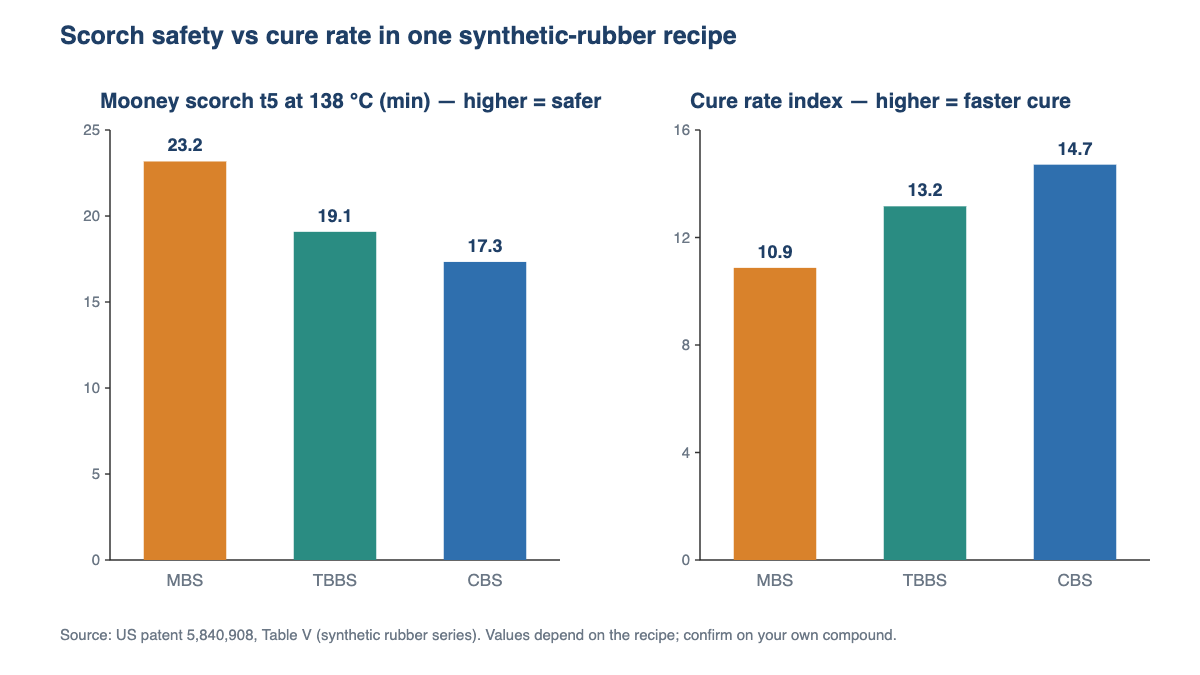
The ranking comes from a US patent that tested all three in the same synthetic-rubber and natural-rubber recipes. In the synthetic compound, Mooney scorch time (t5 at 138 °C) was 23.2 minutes for MBS, 19.1 for TBBS and 17.3 for CBS. The cure rate index ran the other way: 14.7 for CBS, 13.2 for TBBS and 10.9 for MBS. In natural rubber the scorch gap was smaller (MBS 11.8, TBBS 11.4, CBS 10.1 minutes).
In that data the gap between CBS and TBBS is small (cerca de 2 minutes of scorch time in the synthetic recipe), so the choice often comes down to your mixing line. If you have scorch problems on long runs or hot mills, TBBS is the obvious candidate to trial. They are still not identical in cure, so confirm on a rheometer before you change a production recipe.
Chinese CBS and TBBS suppliers, prices and the 2026 US duty
Chinese CBS and TBBS come as powder, oiled powder or granules. The US case describes CBS assays of 94% para 99% and melting points of 90 para 110 °C, so two lots both sold as "CBS" can be quite different. In our trade, much of the lot-to-lot difference comes down to the type of plant behind the lot.
| Supplier type | Preço | What we see on real lots | Suits |
|---|---|---|---|
| Large integrated plants (own upstream raw materials such as the amines, continuous synthesis with in-process control) | Highest: usually 6–12% above smaller plants | Stable initial melting point and assay, small lot-to-lot variation; oil content of oiled powder stays in range; granules are firm and give little dust | Tyres, technical rubber goods, export buyers who audit plants and need steady long-term supply |
| Smaller plants (batch reactors, bought-in raw materials) | Middle | Assay usually meets spec, but initial melting point often sits near the lower limit and moves between lots; weaker crystallisation and cooling control, so more caking in storage; oil content varies; granules break and give dust | General rubber goods and less demanding recipes; acceptance risk with strict North American buyers |
| Traders (no plant; consolidate lots or relabel) | Lowest offer, highest risk | Widest spread in melting point and assay, because lots from several plants are combined; caking and uneven oil content within one shipment; many cannot test and only forward the plant's COA, so lots fail arrival tests more often | Only buyers with wide specs who do no incoming testing |
CBS vs TBBS price. On the Chinese market, TBBS usually costs RMB 1,200–2,200 per tonne more than CBS of the same assay and form. tert-Butylamine costs more than cyclohexylamine, and TBBS has a lower yield and costs more to purify. When raw materials are tight the gap can widen to about RMB 2,500 per tonne; in a falling market it narrows to RMB 800–1,000. Form changes the price too, so compare oiled powder with oiled powder and granules with granules. For why the lowest quote is often not the cheapest in the end, ver why the cheapest chemical offer can create export risk.
The US case is the bigger change this year:
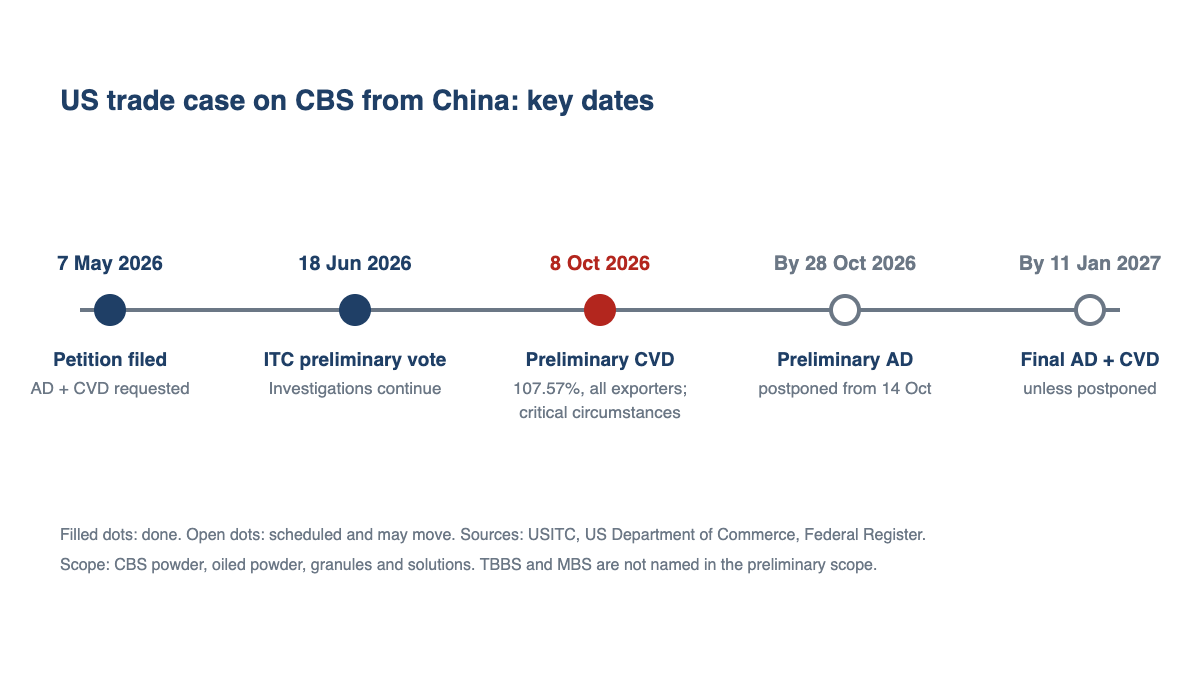
- Petition and injury vote: a petition filed on 7 Poderia 2026 asked for anti-dumping (AD) and countervailing (CVD) duties on CBS from China. The US International Trade Commission made an affirmative preliminary injury vote on 18 Junho 2026, so the investigations continue.
- Preliminary CVD: 107.57% for all Chinese producers and exporters, published on 8 October 2026. Commerce also found critical circumstances, so suspension can reach back to entries made 90 days before that date.
- Still to come: the preliminary AD determination was postponed and is now due by 28 October 2026. Final AD and CVD determinations are due by 11 Janeiro 2027 unless postponed.
- Scope: CBS powder, oiled powder and granules, CBS in solution, and CBS commingled with CBS from other sources. The written scope, not the HS code, decides what is covered.
TBBS and MBS are not named in the CBS scope as published. That makes TBBS a real technical option for US compounders who import their accelerator, but only if it works in your recipe. (This is general information, not legal or customs advice; check with your broker.)
Our US customers are already reacting. A number of them are testing TBBS in place of CBS and asking us for cure and ageing comparison data for their trials, and some have already switched recipes. Others have cut or paused new CBS orders while they test, and a few keep small CBS volumes for older recipes they do not want to touch. Because the two do not cure identically, many who trial TBBS end up with a CBS + TBBS combination rather than a full switch. If you do that, remember that the Chinese CBS in the combination still carries the duty; you simply buy less of it.
Quality problems and what to check before you order
A sulfenamide that looks fine on a one-line COA can still scorch early or cure slowly in your mixer. Ask for measured values, not "conforms", on every lot:
- Initial melting point, the temperature at which the powder starts to melt. A low value points to impurities. As a benchmark, one Western CBS specification sets a minimum of 97 °C.
- Ensaio, with the method named. The same specification sets 95.0% minimum for CBS.
- Heating loss and ash; that specification allows 0.4% moisture at 60 °C and 0.5% ash. China's GB/T 21184 describes test methods for these and for insoluble matter. Premium tyre customers also check free amine.
- Producer, manufacturing date and form (pó, oiled powder or granule, with oil content or granule size), plus a pre-shipment sample from the actual lot.
These are the four problems we meet most often with Chinese CBS and TBBS, and how we deal with them:
| Problem | Usual cause | How we handle it |
|---|---|---|
| Low initial melting point | Incomplete reaction, by-products left in the product | Test before shipment and hold back lots below the limit; write the minimum into the contract, with replacement if the arrival retest fails |
| Caking | High moisture, weak moisture barrier, heat and stacking pressure on a long sea voyage | Moisture limit on the COA, moisture-proof inner liners, cool storage; light lumps can be broken at low speed, hard-caked lots are rejected |
| Dust from granules | Weak granules, poor screening | Harder granules and screening out fines before packing; oiled powder if your process allows it |
| Oil content varies in oiled powder | Unstable spraying or uneven mixing | Oil content tested on every lot against an agreed range; lots outside it are not shipped |
For US-bound goods, add one more line to your RFQ: the HS code, the producer and the exporter. Under the preliminary CVD notice, cash deposits follow the producer and exporter, and today every Chinese producer and exporter has the same 107.57% rate. Price the duty in before you compare offers.
Our recommendation and FAQ
If you make rubber goods in Germany, where TRGS 552 applies, or supply customers who apply it, use CBS or TBBS and keep MBS out unless your customer has approved it in writing. If you import CBS into the US, consider starting a TBBS trial now instead of waiting for the final duty decision in January. For demanding compounds, pay the premium for a large integrated plant; for general rubber goods a well-tested lot from a smaller plant can be fine. Compare every offer on the same basis: plant type, measured initial melting point, assay and form.
What we can do for you: a COA for each lot with the measured initial melting point and assay, plus the MSDS, with acceptance limits written into the contract. We supply oiled powder and granules, with oil content or granule size to your specification, packed in 25 kg PE-lined kraft bags or 500 kg / 1,000 kg bulk bags for container shipping. Ver CBS, TBBS e MBS (NOBS); the rest of the range is on our rubber additives page. For silane coupling agents in the same compounds, ver silanes for rubber and tyre applications.
Can I replace CBS with TBBS one-for-one by weight?
Not quite. TBBS has a lower molecular weight (238.4 contra 264.4 g/mol), so the same number of molecules needs about 10% less TBBS by weight. Start from an equal molar dose and confirm scorch and t90 on a rheometer.
Do CBS and TBBS form nitrosamines?
Both release primary amines, which do not form the stable nitrosamines that regulators target. TRGS 552 lists CBS and TBBS as substitutes for MBS. Your customer may still ask for nitrosamine test data on the finished part.
Does the US duty on CBS also cover TBBS?
Not as the scope reads in the preliminary CVD notice of 8 October 2026. The scope can still be refined before the final determinations, so check the final notice and ask your customs broker before you switch; this is not legal or customs advice.
What does a low initial melting point tell me?
Usually that the lot contains more impurities. It may not behave like your approved lot, so ask for a retest or a fresh lot rather than adjusting your recipe to fit it.
If you want help choosing between CBS and TBBS or comparing offers on the same basis, email me at david@sunchemgroup.com or use our contact page.
Sources — regulation and trade
- Federal Register, 8 Oct 2026: preliminary affirmative CVD determination on CBS from China e ITA rate summary
- Federal Register, 24 Sep 2026: postponement of the preliminary AD determination to 28 Oct 2026
- USITC, 18 junho 2026: vote to continue investigations on CBS from China
- TRGS 552, Annex 4: substitution in rubber manufacturing
Sources — technical data
- NÓS 5,840,908: scorch and cure data for MBS, TBBS and CBS
- Typical Western commercial CBS specification (PDF)
- GB/T 21184-2007: sulfenamide accelerators, métodos de teste
How this guide was made: the cure data and limits come from the patent, specification and standards listed above; the supplier comparison, price gaps, quality problems and customer reactions come from SUNCHEM's own trade in CBS and TBBS. This article was drafted with AI assistance; the supplier data and recommendations come from David and were checked before publishing.