BDP против TPP в PC/ABS: Какой фосфатный антипирен купить??
Key takeaways
- For PC/ABS housings that must pass UL 94 and ship to the EU, buy BDP, not TPP. TPP has been on the EU REACH Candidate List of Substances of Very High Concern (SVHC) since 7 ноябрь 2024.
- BDP works in both the gas phase and the condensed phase in PC/ABS; TPP works only in the gas phase and is a low-melting solid that can bridge in the extruder feed zone.
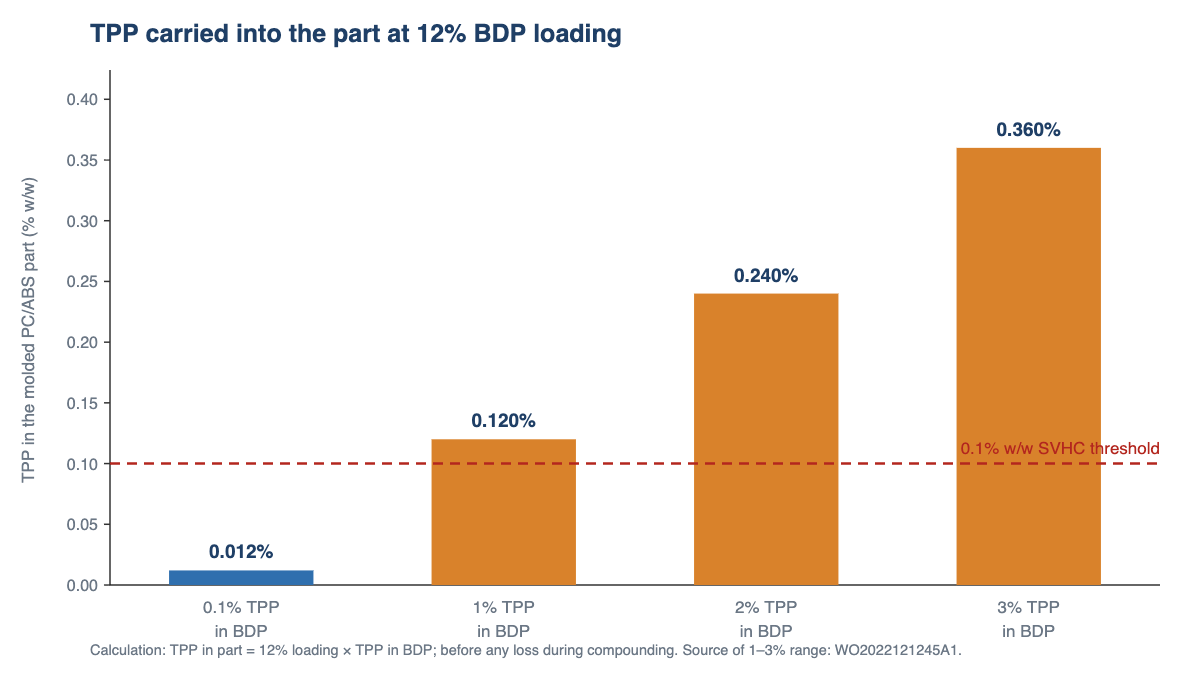
- The hidden risk is TPP inside БДП. Batch-made BDP can carry 1–3% TPP; at a 12% loading, anything above about 0.8% TPP in the BDP puts the molded part over the 0.1% SVHC line.
- Put TPP and isopropenylphenyl diphenyl phosphate (ИПП) by HPLC, and acid value by titration, on the certificate of analysis (сертификат подлинности) for every lot.
By David, Founder & Sales Director, SUNCHEM — 25 years in chemical export sales.
Опубликовано: 8 October 2026
If you compound flame-retardant PC/ABS for electronics housings, chargers or enclosures, choose bisphenol A bis(дифенилфосфат) (БДП) over triphenyl phosphate (ТЭС). BDP gives you better fire performance under forced flaming, avoids the "juicing" (migration to the surface) that TPP is known for, and lets you keep TPP below the EU SVHC threshold — provided you control the TPP left inside the BDP. The first thing to check is not the price per kilo — it is how much TPP the BDP itself contains.
TPP still has a place: it is a simple, widely available commodity. But for PC/ABS sold into regulated markets, the case for it has narrowed sharply since 2024.
Contents
BDP vs TPP: what changes in your PC/ABS
Both are aryl phosphate esters (phosphorus flame retardants built on phenyl groups). They are not interchangeable at the compounder:
| Point | БДП (КАС 5945-33-5 / 181028-79-5) | ТЭС (КАС 115-86-6) |
|---|---|---|
| Физическая форма | Viscous liquid; needs liquid-handling equipment at the extruder | Flakes, melting point about 50 °С; can melt early in the feed zone and bridge |
| Phosphorus content (theoretical) | 8.9% (n=1) | 9.5% |
| Mode of action in PC/ABS | Gas phase plus significant condensed phase (char); synergy with PTFE, the usual anti-drip agent | Gas phase only |
| Fire test behaviour | Better in cone calorimetry (forced flaming) | Better on LOI (limiting oxygen index); weaker under forced flaming |
| EU REACH status | Not on the Candidate List (check the current list) | SVHC since 7 ноябрь 2024 (endocrine disrupting, environment) |
The mechanism data come from BAM's comparison of TPP, BDP and resorcinol bis(дифенилфосфат) (РДП, a close relative of BDP) in PC/ABS (Pawlowski & Schartel, 2007), which also ran LOI, UL 94 vertical-burn and cone calorimeter tests. In my view the condensed-phase action is what matters for thin-wall housings, where char and drip control decide the UL 94 рейтинг.
One thing does not change: aryl phosphates plasticize PC/ABS and lower heat resistance. In one published series, 9.3 wt% RDP cut the heat deflection temperature (HDT) of a 5:1 PC/ABS from 110 °C to 82 °С. Budget for that whichever phosphate you pick.
What Chinese BDP supply looks like
If you buy BDP from China, the process the producer uses can change the impurity profile a lot. One Chinese producer's patent sets out the gap:
- Conventional batch process: according to the patent, conventional BDP typically contains about 1–3% TPP and around 1% isopropenylphenyl diphenyl phosphate (ИПП), an impurity that makes the product darken under light. Moisture and air in batch reactions push TPP up.
- Continuous or tightly controlled processes: the same patent reports TPP held to about 0.1%, IPP below 50 ppm and a colour number below 50.
- What this means for you: two offers both labelled "БДП" can differ ten-fold or more in TPP. If you buy through a trader, ask which plant made each lot so you can compare like with like.
Phosphorus content and acid value alone will not separate these two profiles. If a COA shows only appearance, phosphorus and acid value, ask for TPP and IPP before you compare prices.
Risks to check before you order
The arithmetic is simple. At a 12% BDP loading (mid-range of the 8–15% use level ICL quotes for its RDP-HP), the TPP in the part is 12% of the TPP in the BDP:
- BDP with 0.1% TPP → 0.012% in the part, well below 0.1%.
- BDP with 1% TPP → 0.12% in the part, already over.
- BDP with 2–3% TPP → 0.24–0.36% in the part.
Above 0.1% w/w of an SVHC in an article, EU suppliers of that article must give customers safe-use information (REACH Article 33) and submit a notification to ECHA's SCIP database of articles containing SVHCs. Some TPP may volatilise during compounding, so test the part if you are close to the line. (This is general information, not legal advice.)
Your RFQ and COA should cover:
- TPP content by HPLC, with a limit you set from your loading (≤0.5% gives margin at loadings up to 15%; a high-purity RDP benchmark such as ICL's RDP-HP specifies ≤0.10%).
- IPP content and colour (APHA scale), if the part is light-coloured or exposed to light.
- Кислотное число (mg KOH/g, by titration); one BDP patent targets below 2.0 and preferably below 0.15 after washing and neutralisation.
- Producer name, process type and lot traceability, plus a pre-shipment sample from the actual lot.
Our recommendation and FAQ
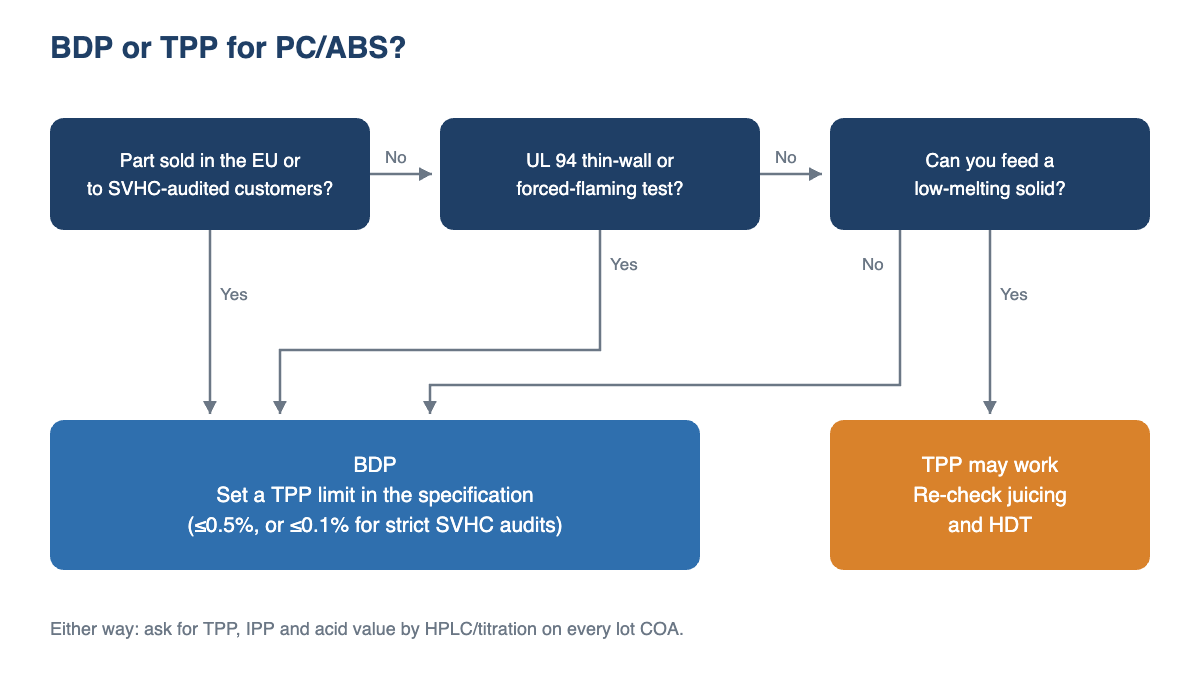
If your PC/ABS goes into electronics sold in Europe, specify BDP with a written TPP limit and ask for HPLC data before you compare prices. Compare offers per kilo of BDP at the same TPP specification; a cheaper offer with 2% TPP is not the same product. TPP only makes sense where the end market does not require SVHC reporting, your fire test is LOI-driven, and you can feed a low-melting solid reliably. We supply both БДП а также ТЭС, and you can see the rest of our range on the flame retardants page. For the wider picture of fire safety materials in electronics, видеть AI data centers and chemical materials.
Can I replace TPP with BDP one-for-one by weight?
Not exactly. BDP has slightly less phosphorus (о 8.9% против 9.5%) and behaves differently in fire tests, so expect to re-run UL 94 and adjust loading and PTFE level. Start from your current phosphorus level and confirm on test bars.
Is BDP itself restricted in the EU?
BDP is not on the SVHC Candidate List at the time of writing. ECHA adds substances regularly, so check the current list before you lock a specification. The practical issue today is the TPP impurity inside BDP.
What TPP limit should I put in my BDP specification?
Work back from your loading: the TPP in the part equals loading × TPP in BDP. At 12% loading you need less than about 0.8% just to stay under 0.1%; we suggest ≤0.5% for margin, or ≤0.1% if your customer audits SVHCs strictly.
Why does my BDP turn yellow in storage?
One likely cause is the IPP impurity, which a producer's patent links to darkening under light. Ask for IPP and colour on the COA and store drums away from light.
If you want help setting a BDP specification or comparing offers on the same basis, email me at Дэвид@sunchemgroup.com or use our contact page.
Sources — regulation and research
- Интертек: ECHA adds triphenyl phosphate to the Candidate List (ноябрь 2024)
- ECHA: Candidate List of substances of very high concern а также SCIP database
- Pawlowski & Schartel, Polymer International 56 (2007) 1404–1414: ТЭС, RDP and BDP in PC/ABS
- Yang et al., Материалы 17 (2024) 5682, citing Levchik et al. on HDT loss in PC/ABS
Sources — patents and product data