Glucosamine HCl vs Glucosamine Sulfate (2KCl or 2NaCl): A Buyer's Guide
If you buy glucosamine for tablets, capsules or powder blends, you will usually be quoted three forms: glucosamine hydrochloride (HCl), glucosamine sulfate potassium chloride (often written "glucosamine sulfate 2KCl") and glucosamine sulfate sodium chloride ("2NaCl"). They are not interchangeable kilo for kilo. By formula, HCl carries about 83% glucosamine base, while the two stabilized sulfate forms carry about 59% and 63%. That gap can affect your label claim, tablet size and cost per dose more than a small price difference between suppliers.
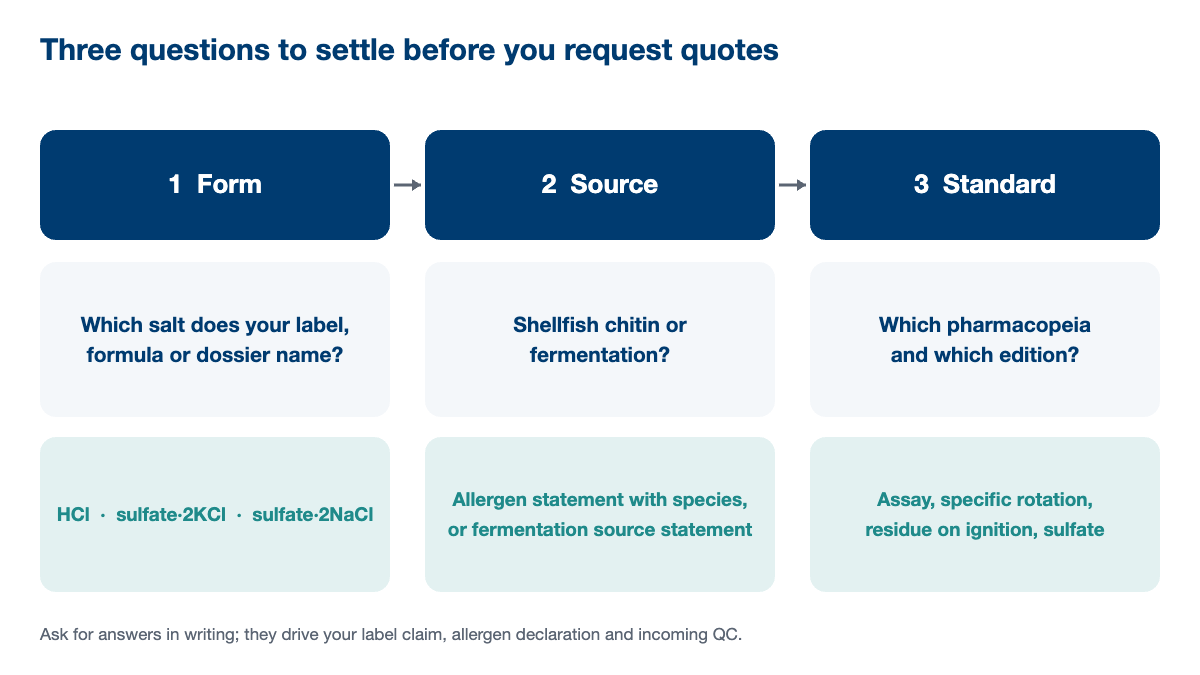
Before you compare quotes, settle three things: which salt form your label, formula or registration names; whether you need a shellfish-free source; and which pharmacopeia edition the supplier tests against.
Quick comparison: HCl vs sulfate 2KCl vs sulfate 2NaCl
Glucosamine is an amino sugar. On its own (as the "free base") it is not a practical ingredient, so it is sold as a salt. The salt you pick decides how much glucosamine is in each gram and what else comes with it.
Glucosamine sulfate has an extra complication. In its pure form it is strongly hygroscopic (it pulls in moisture from the air) and degrades quickly. A 1987 patent from Rotta Research Laboratorium (US 4,642,340) reports that crystallizing it together with sodium chloride produced a stable mixed salt. That is why commercial "glucosamine sulfate" is normally sold with two molecules of NaCl or KCl built in, and why it carries less glucosamine per gram.
| Point to compare | Glucosamine HCl | Glucosamine sulfate 2KCl | Glucosamine sulfate 2NaCl |
|---|---|---|---|
| USP (United States Pharmacopeia) formula | C6H13NO5·HCl | (C6H14NO5)2SO4·2KCl | (C6H14NO5)2SO4·2NaCl |
| Molecular weight | 215.63 | 605.52 | 573.31 |
| Glucosamine base by weight* | ≈83% | ≈59% | ≈63% |
| Mineral added by the stabilizing salt* | None | ≈12.9% potassium | ≈8.0% sodium |
*Calculated from the USP molecular formulas for pure material. Real content also depends on the assay result and moisture of each batch.
How this usually plays out in practice:
- Choose HCl when your label or registration allows "glucosamine hydrochloride" and you want the highest glucosamine per tablet. Fermentation-derived (non-shellfish) grades are commonly offered in this form, but confirm the source for any form.
- Choose sulfate 2KCl when your market or brand expects "glucosamine sulfate" and you want to avoid added sodium. Check the potassium it adds per daily serving.
- Choose sulfate 2NaCl when you are matching an existing product or file built on that form. Account for the sodium in your nutrition or supplement facts panel.
- Do not swap forms in an existing product without redoing the label calculation, stability check and regulatory review.
Why "1,500 mg" means different things by form
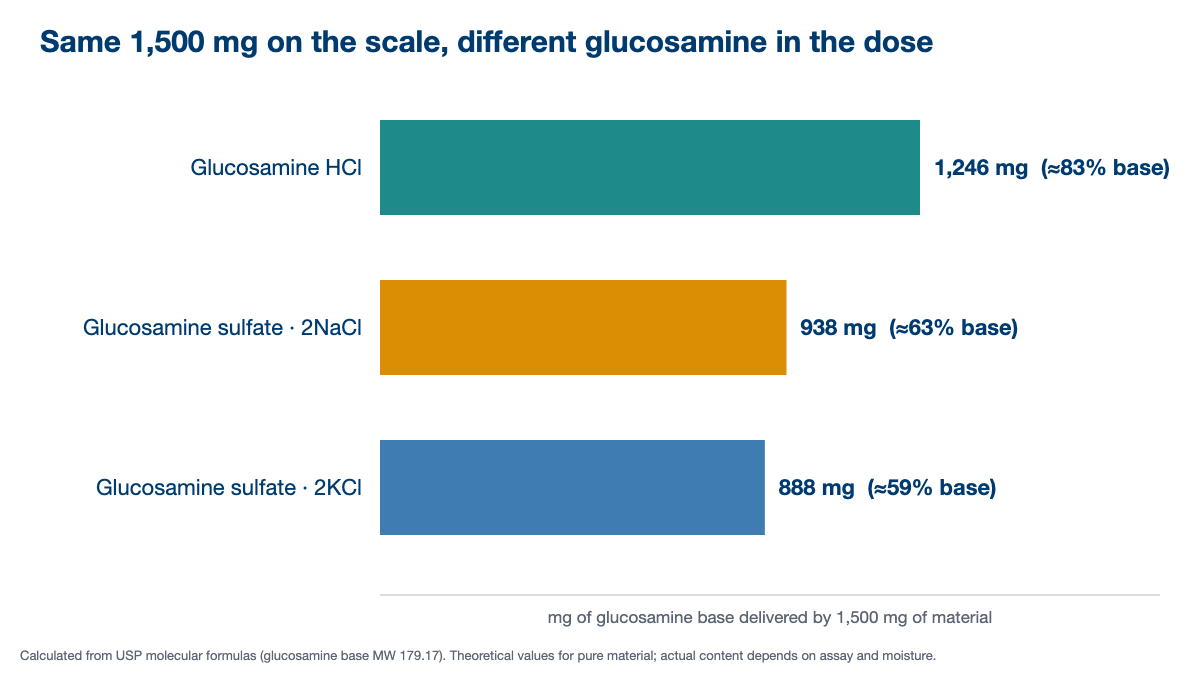
Many joint products are built around a daily amount of 1,500 mg. The question a buyer must answer first is: 1,500 mg of what? The same weight of each material delivers a very different amount of glucosamine.
| 1,500 mg of material | Glucosamine base | Added sodium or potassium |
|---|---|---|
| Glucosamine HCl | ≈1,246 mg | None |
| Glucosamine sulfate 2NaCl | ≈938 mg | ≈120 mg sodium |
| Glucosamine sulfate 2KCl | ≈888 mg | ≈194 mg potassium |
There is a second trap. Some labels state "glucosamine sulfate" calculated as the salt-free sulfate, (C6H14NO5)2SO4 (MW 456.4). On that basis, 1,500 mg of glucosamine sulfate equals about 1,178 mg of glucosamine base. To deliver that from a salt-stabilized material, you need roughly 1,885 mg of the 2NaCl form or about 1,990 mg of the 2KCl form. That can mean a larger tablet or an extra capsule. Which basis your label may use depends on your market's rules, so agree on it with your regulatory team before you send a request for quotation (RFQ). Other calculation bases exist, so confirm which one your supplier and label team mean.
Compare price per kilogram of glucosamine base, not per kilogram of material. Divide each quote by the base fraction (about 0.83, 0.63 or 0.59). At the same price per kilogram, HCl delivers about 40% more glucosamine than the 2KCl form and about 33% more than the 2NaCl form.
Source, allergen and claim checks
Glucosamine is made by two main routes:
- Shellfish route: chitin from shrimp or crab shells is broken down with acid.
- Fermentation route: one documented process uses the fungus Aspergillus niger in a dextrose-based fermentation, followed by acid hydrolysis and crystallization to glucosamine HCl. These grades are often sold as "vegetarian" or "non-shellfish" glucosamine.
The source matters for your label, not only for marketing. In the United States, crustacean shellfish is one of the nine major food allergens, the specific species (for example shrimp or crab) must be declared, and FDA states that this covers dietary supplements. In the EU, crustaceans are also on the list of allergens that must be emphasized on food labels. So ask for a signed source statement that names the species, or confirms fermentation origin. Do not rely on a "vegetarian" word on a quote.
Be careful with health claims too. The European Food Safety Authority (EFSA) concluded that a cause-and-effect relationship had not been established between glucosamine and maintaining normal joint cartilage in people without osteoarthritis. The U.S. National Center for Complementary and Integrative Health describes study results for glucosamine as inconsistent. A supplier's certificate of analysis (COA) confirms identity and purity. It does not support any claim about what the product does in the body. Claims and warnings are the brand owner's responsibility under its own market's rules.
COA checks and RFQ questions
The USP–NF has a monograph for each of the three forms. The ranges below are from the USP 35 text. Later editions may revise tests (for example, replacing the old heavy metals test with elemental impurities), so confirm the edition your supplier tests against.
| Test | HCl | Sulfate 2KCl | Sulfate 2NaCl | What it tells you |
|---|---|---|---|---|
| Assay (liquid chromatography, dried basis) | 98.0–102.0% | 98.0–102.0% | 98.0–102.0% | Purity of the declared salt form |
| Specific rotation | +70.0° to +73.0° | +47.0° to +53.0° | +50.0° to +55.0° | A fast identity check; separates HCl from the sulfate forms (the 2KCl and 2NaCl ranges overlap) |
| Residue on ignition | ≤0.1% | 26.5–31.0% | 22.5–26.0% | The stabilizing salt shows up as ash; HCl should be almost ash-free |
| Sulfate | ≤0.24% | 15.5–16.5% | 16.3–17.3% | Separates HCl from the sulfate forms |
All three monographs also set pH at 3.0–5.0 and loss on drying at not more than 1.0%, and ask for storage in tight, light-resistant containers.
Questions to put in your RFQ:
- Which exact form and formula is offered? For sulfate grades, is it a crystallized mixed salt, and how is it produced?
- What is the raw material source: which shellfish species, or which fermentation organism and feedstock? Please provide a signed statement.
- Which pharmacopeia and edition does the COA follow? Please send a recent batch COA showing assay, specific rotation, residue on ignition, sulfate, elemental impurities and microbiology.
- Which physical grade is offered (fine powder or granular for direct compression), with particle size and bulk density?
When samples arrive, specific rotation, residue on ignition and sulfate are quick, low-cost tests that catch a common mix-up: receiving HCl instead of a sulfate form, or the reverse. Residue on ignition plus a sodium or potassium identity test tells 2KCl from 2NaCl. For a wider view of the documents to request, see our guide to COA, SDS/MSDS and TDS for chemical importers.
Next step
Review the Glucosamine HCl, Glucosamine Sulfate Potassium and Glucosamine Sulfate Sodium pages, or browse our amino acids and nutraceuticals range. When you are ready, contact our team or email david@sunchemgroup.com with your target form, label basis, source requirement and pharmacopeia edition. We will check which producers we work with can document those points and share their batch COA and source statements for your review.